Engine
Mercedes M272/M273 Balance Shaft: Years, Checks and Cost
· 14 min read · Mercedes Benz Repair Dallas
What does M272/M273 balance shaft repair cost in Dallas?
A Mercedes-Benz M272 V6 or M273 V8 built from 2005 through about 2008 can wear its sintered-metal balance shaft sprocket (V6) or timing idler gear (V8) until the camshafts fall out of correlation with the crankshaft, setting P0016 through P0019 and a check engine light that will not stay off. At our independent Mercedes shop serving Dallas and the cities within 30 miles of east Dallas, the complete job runs $2,800–$6,500 as a typical independent-shop range: $4,200–$6,500 for an M272 balance shaft, $3,200–$5,000 for an M273 idler gear, and $2,800–$4,800 for chains, guides and tensioners alone. Engine-out versus engine-in and how many seals get done while the front is open move the number. If you have a 2005–2008 C, E, ML, CLK, SLK or R-Class with these codes, email service@mercedesbenzrepair.net and we will read the serial number and the cam deviation values before anyone quotes a figure.
What actually wears inside the M272 and M273?
The M272 is the aluminum 90-degree V6 Mercedes introduced in 2004, and the M273 is the V8 derived from it a year later, per the M272 and M273 engine histories. Both use a chain-driven valvetrain with four camshafts and a single primary timing chain, plus secondary gearing at the front of the block. On the V6, that gearing includes a balance shaft that runs the length of the block in the valley to cancel the rocking couple a 90-degree six produces. The shaft is turned by a sprocket on its nose that the primary chain wraps around on its way up to the cylinder heads.
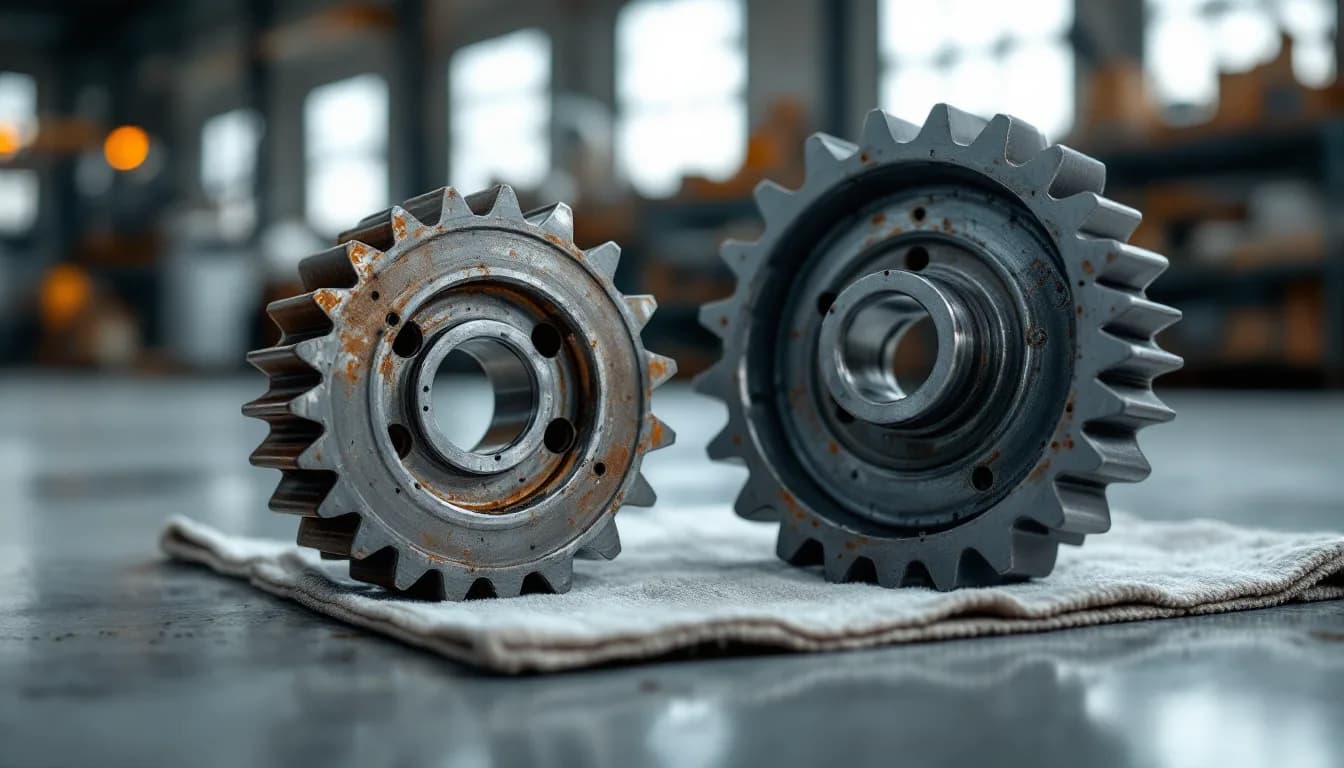
On early engines that sprocket was made from a sintered powder-metal alloy that turned out to be too soft for the duty. The chain polishes the teeth to thin, hooked points, the chain effectively takes a longer path around the gear, and every bit of slack shows up as retarded camshaft timing on the bank fed downstream of that sprocket. The V8 has no balance shaft because a 90-degree eight is naturally balanced, but it uses an idler gear in the same spot to route the chain, and the early idler gear used the same soft material and fails the same way.
The wear is slow, mechanical and permanent. There is no software update, no additive and no oil change that reverses it. What oil quality and change intervals do affect is how quickly the hooked teeth chew the chain, the plastic guide rails and the tensioner, which is why two engines with the same sprocket can present very differently at the same mileage.
Which model years and engine serial numbers are affected?
The documented range comes from the class-action settlement in Seifi v. Mercedes-Benz USA, LLC, which covered model year 2005–2007 vehicles with M272 engines up to serial 2729..30 468993 or M273 engines up to serial 2739..30 088611, according to the settlement notice posted by NHTSA. Engines above those serial numbers received a hardened sprocket or idler gear from the factory. Because production of the updated parts overlapped the 2008 model year on some lines, the advice commonly repeated among Mercedes technicians is to check every M272 and M273 built through about 2008 rather than trust the model year on the title.
That puts the following Dallas-common cars on the watch list: W203 C230, C280 and C350 and the 2008 W204 C300 and C350; the W211 E350 and E550 (the E-Class page on this site covers the W211 and its successors); the W164 ML350 and ML550; the C209 CLK350 and CLK550; the R171 SLK280 and SLK350; the W251 R350 and R500; the X164 GL450 and GL550; the W221 S550; and the C219 CLS550. A 2009 car with a late-build engine is almost never affected, and a 2005 car whose sprocket was already replaced under the settlement carries the hardened part today.
Serial number, not model year, is the thing that decides it. Two 2007 E350s parked side by side can have a soft sprocket in one and a hardened one in the other depending on the week the engines were built.
What do P0016, P0017, P0018 and P0019 mean on these engines?
All four codes are crankshaft-to-camshaft correlation faults. The engine control unit compares the crankshaft position sensor against the four Hall-effect camshaft sensors and knows where each camshaft's reference edge should sit when the cam adjusters are at their base position. When the measured relationship drifts past a tolerance window, the ECU logs the correlation code for that camshaft:
- P0016: bank 1 intake camshaft to crankshaft.
- P0017: bank 1 exhaust camshaft to crankshaft.
- P0018: bank 2 intake camshaft to crankshaft.
- P0019: bank 2 exhaust camshaft to crankshaft.
Mercedes numbers the right bank, cylinders 1 through 3 on the V6 and 1 through 4 on the V8, as bank 1. Which bank reports first depends on the chain path and how the slack distributes around the worn gear, and in the pattern we see the codes usually arrive one bank at a time rather than all four at once. A single code that clears for weeks and returns is typical early; a pair on the same bank that returns within one drive cycle means the deviation is now outside the window at idle, not just under load.
The ECU does not know why the camshaft moved. The same codes can be caused by a stretched primary chain, a failed cam adjuster (the phaser bolted to the camshaft nose), a stuck cam adjuster solenoid magnet, a sheared adjuster lock pin, low oil pressure starving the phasers, or a wiring fault at a cam sensor. The balance shaft diagnosis is made by ruling those out and reading the deviation numbers, not by the code alone.
How do we check whether a specific car has the problem?
A proper inspection takes about an hour and a half on a lift and answers three questions: is this engine in the affected serial range, how far have the camshafts drifted, and is the drift consistent with gear wear rather than chain stretch or an adjuster fault. We book it as a XENTRY diagnostic session.
Where is the engine serial number?
The engine number is stamped into a machined pad on the block, on the left side toward the rear, below the head and close to the bellhousing. It is readable from underneath with the car on a lift and an inspection mirror, and on some chassis from above once the engine cover and air filter housings are off. It reads as a type number (272.9xx or 273.9xx) followed by a two-digit code and a six-digit sequence, which is why the settlement expresses the cutoffs as 2729..30 468993 and 2739..30 088611. The factory data card for the VIN also lists the engine number as built, but the block stamping is the authority if an engine was ever swapped.
What do the XENTRY camshaft deviation values show?
XENTRY reads live actual values from the engine control unit, including the measured position of each camshaft relative to the crankshaft in degrees of crank angle and the adaptation values the ECU has learned to compensate. A healthy M272 shows all four camshafts within a few degrees of their nominal base position with the adjusters commanded fully retarded. As the sprocket wears, the actual value on the affected bank reads progressively more retarded, and the ECU's learned offset grows with it until it runs out of authority and sets the code. We record all four values, warm and at idle, and compare the two banks against each other as well as against spec.
How do you tell balance shaft wear from a stretched chain?
This is the confusion that leads to the wrong repair. A stretched primary chain retards both banks together, because the chain runs over both sets of cam sprockets after it leaves the crank, and it tends to produce a rattle on cold start as the tensioner takes up the extra length. Wear at the balance shaft sprocket or idler gear shows a larger offset on one bank than the other, because the chain path to that bank passes over the worn gear while the other bank is referenced more directly, and it is usually quieter. In our experience a car with a split of several degrees between banks and a serial in the affected range has a worn gear until proven otherwise; both banks equally retarded points more often to chain stretch, worn guides or an adjuster problem.
Why is this an engine-out or front-of-engine job?
The balance shaft on the M272 lives inside the block, in the valley above the crankshaft, and slides out through the front once the timing case is off. Getting to the timing case means removing the front cover, which sits behind the accessory drive, water pump, crank damper and oil pan rail. On a W211 or W203 there is barely enough room between the radiator support and the front of the engine to pull the cover with the engine in the car, and no room at all to withdraw the shaft. In practice that means lifting the engine out or dropping the front subframe and rolling the engine forward on a cradle, and both take comparable labor. The M273 idler gear is on the front of the block rather than inside it, so on some V8 chassis with more clearance it can be reached with the engine in place, which is one reason the V8 line item is lower than the V6 figure.
Either way, the chains, guides, tensioners and front seals come off as a consequence of the access, and the oil pan, oil cooler and valve covers are disturbed, which is why a competent estimate bundles those items rather than opening the engine twice.
What does the repair include?
The core of the job on the V6 is the updated balance shaft with a hardened sprocket, fitted as a complete assembly because the sprocket is pressed to the shaft. On the V8 it is the updated idler gear with its bearing and bolt. Around that core we replace:
- the primary timing chain and both secondary chains, since the hooked teeth have been filing the rollers for tens of thousands of miles;
- every plastic chain guide and tensioner rail, which embrittle with age and heat and are the next failure on a chain that has been running slack;
- the hydraulic chain tensioners, including the inner spring-loaded units at the heads;
- the front crank seal, the timing cover gasket and sealant, and the camshaft adjuster magnet seals that weep oil into the connector and down the back of the engine;
- the oil pan gasket and, because the cooler sits in the valley on these engines and must come off for the job, the oil cooler seals that are the most common leak source on an M272 at this age (details on the oil leak page).
We inspect the camshaft adjusters for lock pin wear, the exhaust cam sprockets for hooking, and the cam sensor wheels. Adjusters that show play get replaced while the chain is off. After reassembly the timing is verified with locking tools, not by eye, the engine is primed, and XENTRY is used to reset the camshaft adaptation values and confirm all four actual values sit at nominal before the car leaves.
Reusing the old chain on a new gear, or skipping the guides because they look fine, saves money on the invoice and comes back as a return visit.
What does M272/M273 balance shaft and timing work cost in Dallas?
The figures below are typical independent-shop ranges in Dallas. Within each range, the chassis (engine-out on a W211 sits higher than engine-in on an ML), the amount of added seal and cooler work, and whether the cam adjusters need replacing move the final number.
| Job | Typical Dallas independent-shop range | What moves it |
|---|---|---|
| M272 balance shaft (shaft, chains, guides, tensioners, seals) | $4,200–$6,500 | Engine-out versus engine-forward, cam adjuster condition |
| M273 idler gear (gear, chains, guides, tensioners, seals) | $3,200–$5,000 | Engine-in access on the chassis, adjuster condition |
| M272/M273 timing chain, guides and tensioners only | $2,800–$4,800 | Whether the gear is confirmed good, chassis access |
| Oil cooler seals, done with the timing job | $650–$1,100 | Large labor overlap with the timing work |
| Valve cover gaskets, pair | $550–$950 | Usually bundled, breather and spark plug well condition |
| Cam adjuster magnet seals | $250–$450 | Whether the harness connectors are oil-soaked |
| XENTRY diagnostic session with cam deviation readout | $149–$229 | Required before any balance shaft quote |
The balance shaft and timing chain service page lists the full scope and range. Written estimates here are ranges with the work itemized, and the number tightens once the cover is off and the adjusters have been inspected.
For scale, the AAA Your Driving Costs study for 2024 puts the average cost to own and operate a new vehicle at $12,297 a year, with depreciation alone about $4,680 of that, according to AAA. A one-time balance shaft repair on a paid-off E350 that is otherwise sound is less than a year of that figure and removes the engine's most expensive known weakness.
What happened with the class-action settlement?
The suit was filed in October 2012 in the Northern District of California as Seifi v. Mercedes-Benz USA, LLC, case 3:12-cv-05493. The settlement gave owners of MY2005–2007 cars with affected serials a sliding-scale extended warranty for balance shaft and idle gear replacement up to the lesser of 10 years or 125,000 miles, provided no sprocket or idle gear had already been replaced after October 2006, as described in the NHTSA-posted settlement notice. Owners who had paid out of pocket could file for reimbursement on the same sliding scale.
The claim deadline was September 25, 2015, and the settlement is listed as closed by Top Class Actions. The 10-year clock has also run out for every vehicle in the class, since the newest covered car was a 2007. In plain terms, nobody is going to reimburse this repair in 2026. Its practical value today is that it tells you which serials Mercedes itself treated as defective, and it explains why some of these cars already carry hardened parts: a dealer fitted them under the program a decade ago.
Independent repair does not affect any remaining factory or extended coverage on other systems. The Federal Trade Commission's consumer guidance on auto warranties notes that the Magnuson-Moss Warranty Act "makes it illegal for manufacturers or dealers to claim that your warranty is void" because someone other than the dealer did the work, and that coverage can be denied only for a failure the outside work caused, per the FTC.
Should you buy a 2005–2008 Mercedes with one of these engines in Dallas?
Yes, with the inspection done first and the result priced into the offer. These are otherwise durable engines, the cars around them are inexpensive to buy now, and a car that has already had the hardened gear fitted is arguably a better bet than a later car with an unknown chain. The order we suggest to buyers:
- Get the VIN and ask the seller for the engine number or for any invoice mentioning balance shaft, idler gear or timing chain work.
- Check the serial against the settlement cutoffs. Above the cutoff, the gear was hardened at the factory and you can move on to the usual oil leak and suspension checks.
- Below the cutoff with no replacement history, budget the repair as if it will be needed, because at this age the gear is worn whether or not the light is on yet.
- Before money changes hands, have the cam deviation values read on XENTRY. A clean scan with all four cams at nominal and no stored P0016–P0019 history is the only reassurance that costs less than the job.
Pull the free NHTSA recall and TSB lookup by VIN as well. The balance shaft issue was never a safety recall, so it will not appear there, but open recalls on other systems are worth closing first. Emissions matter too: gasoline vehicles 2 through 24 years old registered in Dallas County get an OBDII emissions test under the Texas DPS program, and a stored correlation code with the light on fails that test at registration time.
What happens if you keep driving with the codes?
For a while, not much that you will feel. The engine runs slightly off its ideal cam timing, fuel economy drops a little, and the check engine light stays on. The hidden cost is in the chain and guides: every mile with hooked gear teeth shortens the life of the rollers and the plastic rails, and a guide that breaks drops fragments into the pan and can let the chain jump. A jumped chain on an interference engine bends valves, at which point the repair involves cylinder heads as well as everything in the table above.
How is the repair warranted?
Every balance shaft, idler gear and timing chain repair we perform is covered for 2 years parts and 2 years labor, up to 24,000 miles, nationwide. On a job of this size that coverage matters, because it spans the period in which a reused part or a missed adjuster would show itself. The scope goes on paper as an itemized range before the engine comes apart, and the XENTRY readout of the cam values before and after is the proof that the timing is where it should be. One more number is worth having in mind when you choose who does the job: the Bureau of Labor Statistics puts the 2024 median pay for automotive service technicians at $49,670 a year across 805,600 jobs nationally, per the BLS Occupational Outlook Handbook, and a shop that keeps a technician who has done many of these engine-out jobs is spending your money where it counts.
For the rest of what we do on these cars, from oil leaks to 722.9 transmission service, the Mercedes repair hub is the place to begin.
Where do these figures come from?
- M272 engine history: Wikipedia, Mercedes-Benz M272 engine
- M273 engine history: Wikipedia, Mercedes-Benz M273 engine
- Settlement terms, serial cutoffs and the 10-year/125,000-mile coverage: NHTSA-posted settlement notice, Seifi v. Mercedes-Benz USA
- Claim deadline of September 25, 2015 and closed status: Top Class Actions
- Annual ownership cost of $12,297 and depreciation of about $4,680: AAA Your Driving Costs 2024
- Technician median pay of $49,670 and 805,600 jobs in 2024: BLS Occupational Outlook Handbook
- Independent repair and your warranty: FTC, Auto Warranties and Routine Maintenance
- Texas emissions testing in Dallas-area counties: Texas DPS
- Recall and TSB lookup by VIN: NHTSA