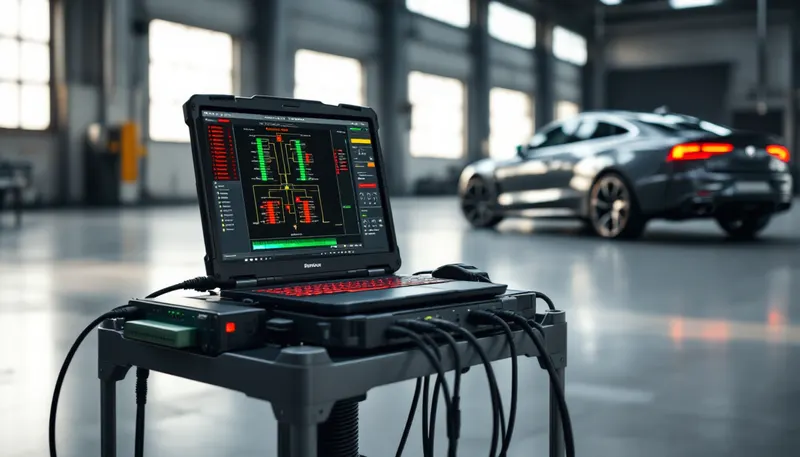
XENTRY Diagnostics
Factory XENTRY scan, guided tests, SCN coding
- Price range
- $149–$229
- Typical time
- 1–1.5 hours

$350–$3,200 · 2–8 hours
Conductor plate, valve body and fluid service for the seven-speed automatic in 2004 and later Mercedes-Benz cars, coded and adapted in XENTRY.
Repairs covered by a 2-year/24,000-mile warranty, independent shop
Symptoms
Problem
Cold-start limp mode, clears after a key cycle
Likely cause
Cracked solder at a conductor plate speed sensor
The fix
New plate with SCN coding, fluid and filter
Problem
No reverse, forward gears normal
Likely cause
Plate output sensor or a valve body pressure fault
The fix
XENTRY data decides plate or valve body first
Problem
Harsh 2-3 upshift when warm, no warning light
Likely cause
Valve body solenoid wear, adaptations at their limit
The fix
Adaptation reset first; valve body if the data confirms
Problem
Shudder at 30–50 mph under light throttle
Likely cause
Torque converter lock-up chatter on aged fluid
The fix
Fluid service with relearn; converter if it stays
Problem
Oily residue in the connector or harness
Likely cause
Hardened pilot bushing at the 13-pin connector
The fix
New bushing and O-rings during the fluid service
The 722.9 is the seven-speed automatic Mercedes-Benz introduced for the 2004 model year, first on the W220 S-Class and W211 E-Class V8s, then across nearly the whole range: W203 and W204 C-Class, W212 E-Class, W221 S-Class, C219 CLS, W164 ML, X164 GL and most AMG models until the MCT and nine-speed units took over.
Its control electronics sit inside the transmission. The conductor plate carries the transmission control unit, the two input speed sensors and the output speed sensor, and the solenoid connectors, all submerged in fluid and bolted to the valve body. That layout is compact, and it is also the source of the unit's well-known failure.
Later units, from 2010 onward, received the 722.9 Plus revisions with a different fluid specification and updated software. The differences matter when ordering fluid and when judging whether a shift complaint is hardware or a calibration Mercedes has since revised.
The speed sensors on the conductor plate are Hall-effect elements soldered to a board that lives in hot transmission fluid for years. Solder joints crack, and the sensor signal becomes intermittent, usually first on cold starts and then permanently. The control unit sees an implausible speed, stores P0717, P0718 or P0722, and drops the transmission into limp mode to protect itself.
Limp mode on a 722.9 means the transmission is held in a single gear, usually second or third, with no shifts and often no reverse. The car moves, slowly, and the cluster may show only a blank gear indicator. Cycling the key sometimes restores normal operation for a drive or two, so many owners live with it until it becomes permanent.
Cars from 2004 to 2010 are the ones most affected, which matches the W211, C219, W221, W164 and early W204 population in the Dallas area. The repair is a new conductor plate, $1,300–$2,200 with coding, done through the pan with a fluid and filter service at the same time.
The conductor plate holds the transmission control unit, and a new one arrives blank. It must be told which car it is in: engine, axle ratio, 4Matic or not, the shift program for that model, and the VIN. Mercedes supplies that configuration online through SCN coding in XENTRY. Without it the plate either does not communicate or the car runs with the wrong shift map and sets faults.
A used plate from another car is married to that car's VIN and carries its adaptation values. Some can be reset through a specialist virginizing service; most cannot, and a used plate from a 2007 W211 does not know what to do in a 2009 W204. We fit new plates and code them, because the labor to go into the pan twice costs more than the price difference.
After coding, the adaptations are reset and the car is driven through a relearn cycle so the new unit learns the clutch fill times for your transmission's wear state. The first few miles can feel slightly firm until that completes.
Mercedes originally described the 722.9 as filled for life, and many cars went well past 100,000 miles on the factory fill. The factory later published a change interval, and independent experience is blunt: the fluid darkens, the filter loads with clutch material and the valve body wears faster in a transmission that never had its fluid changed.
A fluid and filter service at a regular interval, sooner on a car that tows or sits in Dallas traffic, costs little next to what it prevents in this transmission. It also gives a look inside the pan: a light grey film on the magnets is normal, heavy metallic sludge is a warning.
A correct service uses the fluid your unit specifies: MB 236.14 for pre-2010 units and the blue MB 236.15 for 722.9 Plus units, never a universal ATF. The pan comes off, the filter and gasket are replaced, the magnets are cleaned, and the electrical connector's pilot bushing, the plastic sleeve sealing the 13-pin connector, is replaced because it hardens and lets fluid wick into the harness.
The fill is the part most often done wrong. The 722.9 has no dipstick; it is filled through the overflow tube with the transmission at a specified fluid temperature, read in XENTRY, until fluid just drips from the tube. Too cold and the unit ends up overfilled, too hot and it is low, and either shows up as a shift complaint a week later.
The visit ends with an adaptation reset where the fluid change is significant, and a road test. The service is $350–$550 depending on the fluid specification and the quantity the unit holds.
The valve body routes fluid to the clutches through solenoids that modulate pressure. When the solenoids wear or their bores score, the result is a harsh or flared upshift, usually 2-3 or 3-4 when warm, a bump into Drive, or a delayed engagement. The speed sensors are fine, so there may be no limp mode and no stored fault, only adaptation values at their limits.
XENTRY shows those adaptation values, and a road test with live data shows the pressure and slip at each shift. When the valve body is the cause, the repair is a new or remanufactured valve body supplied with a conductor plate already fitted, coded to the car, $1,900–$3,200. On a car that also has a speed sensor fault, the combined unit is usually the better value.
Shift complaints on a healthy valve body sometimes respond to the current software calibration or an adaptation reset, $120–$180, and we try that first where the adaptation data supports it, because it is the least invasive fix.
A shudder at light throttle between about 30 and 50 mph is often the torque converter lock-up clutch, which responds to a fluid service and a relearn in many cases and needs a converter in others. A vibration at idle in Drive is usually engine mounts, especially on W204 and W211 cars, and a clunk on take-up is the driveshaft flex disc or a center support bearing.
An engine misfire under load feels like a transmission slip, and a weak battery can produce a transmission fault at start. We read the whole car before condemning the transmission, so the first step is a XENTRY session, not a quote.
Our range is $350–$3,200. A fluid and filter service is $350–$550, an adaptation reset or calibration update $120–$180, a conductor plate with coding $1,300–$2,200 and a valve body with conductor plate $1,900–$3,200. 4Matic cars may add time for access.
The written estimate names the part, the fluid specification for your unit and the coding step. Transmission repairs are covered for 2 years parts and 2 years labor, up to 24,000 miles, nationwide.
Conductor plates are new, genuine Mercedes or the original manufacturer's unit, because a plate that will not accept SCN coding is useless. Valve bodies are new or remanufactured by a specialist with the plate installed and tested. Pans with integrated filters, gaskets and connector sleeves are genuine or original-supplier parts.
Fluid is MB 236.14 or 236.15 as the build date requires, in the quantity the unit holds; 4Matic cars take more. The price moves with the failed component, with whether a plate or a full valve body is required, and with access on 4Matic and AMG installations.


Pricing
| Service | Price range | Typical time |
|---|---|---|
| Fluid and filter service | $350–$550 | 2–3 hours |
| Conductor plate (TCU) with SCN coding | $1,300–$2,200 | 4–6 hours |
| Valve body with conductor plate, coded | $1,900–$3,200 | 5–8 hours |
| Adaptation reset or calibration update | $120–$180 | |
| XENTRY diagnosis | $149–$229 |
Dallas-area independent ranges; a plate or valve body job includes the fluid and filter that come out anyway.
The offer
Risk reversal
Covered for 2 years parts and 2 years labor, up to 24,000 miles, nationwide
No deposit, no card online: you approve the written range before any part is ordered
Published range
$350–$3,200
2–8 hours
Models
Questions
On a 2004–2010 722.9 that pattern is the conductor plate's speed sensors in most cases. We confirm in XENTRY from the stored faults and live sensor signals, then replace and code the plate with a fluid and filter service in the same visit.
We do not. A used plate is coded to another VIN and carries that transmission's adaptations; most cannot be recoded, and those that can need a specialist reset first. Opening the pan twice to replace a failed used plate costs more than the saving.
Despite the filled-for-life description, a regular fluid and filter service protects this transmission more than anything else, and the factory later published an interval. Cars that tow or live in Dallas traffic should go sooner. Pan filter and connector sleeve are replaced each time and the fill is set at temperature in XENTRY.
The 13-pin connector on the side of the 722.9 is sealed by a plastic pilot bushing that hardens with heat. Fluid wicks past it into the harness and can travel toward the engine control unit. The bushing is replaced at every fluid service.
Sometimes. If the harshness comes from old fluid and adaptations at their limits, a fluid service with an adaptation reset improves it noticeably. If the valve body solenoids are worn, the change helps briefly and the shift quality returns to where it was. The XENTRY data tells us which case you have first.
The work fits inside a day: pan off, plate replaced, pan and filter on, fill at temperature, then SCN coding online and an adaptation drive. Coding depends on the Mercedes server, so we schedule a full day. Plate and labor are covered for 2 years parts and 2 years labor, up to 24,000 miles, nationwide.
Related
Factory XENTRY scan, guided tests, SCN coding

M272 balance shaft, M273 idler gear, chains and guides

Book 722.9 7G-Tronic Transmission Service and Repair in Dallas
Service and repair for the 722.9 7G-Tronic automatic: conductor plate with SCN coding, valve body, fluid and filter service with MB 236.14 or 236.15 fluid, and adaptation resets in XENTRY.