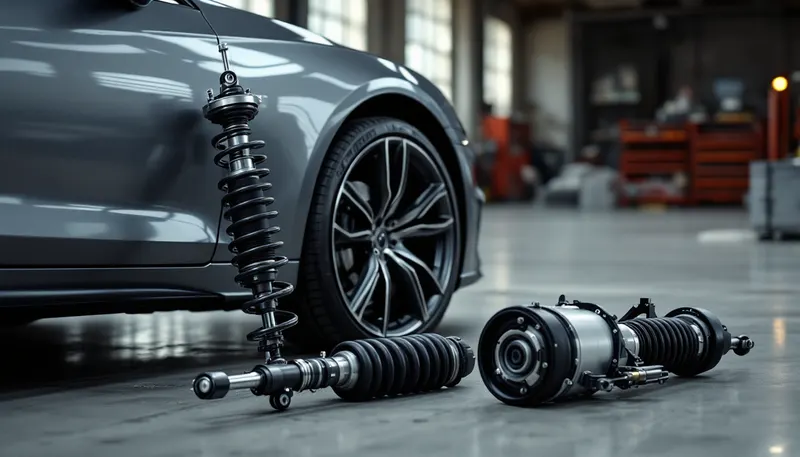
Airmatic Air Suspension Repair
Air struts, compressor, valve block, leak tracing
- Price range
- $450–$2,400 per repair
- Typical time
- 2–6 hours
$350–$2,900 per repair · 2–8 hours
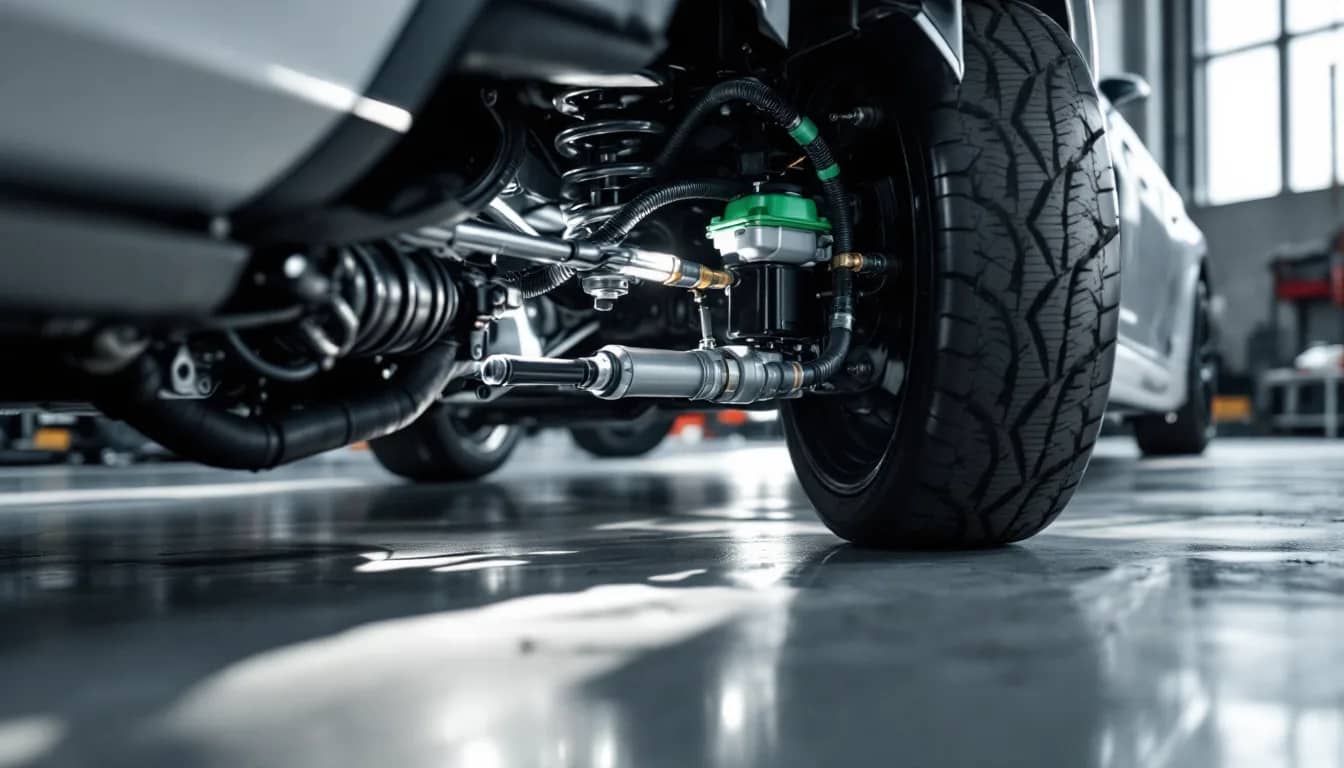
Hydraulic Active Body Control work on CL, S-Class and SL models, from the fluid flush that extends the system's life to struts and the tandem pump, calibrated in XENTRY.
Repairs covered by a 2-year/24,000-mile warranty, independent shop
Symptoms
Problem
Front corner drops within hours of shutdown
Likely cause
Strut rod seal failed, fluid down the spring
The fix
Strut with seals, then calibration
Problem
Slow rise after start, whine following the steering
Likely cause
Tandem pump worn by dirty fluid or low level
The fix
Pump, pulsation damper check and a full flush
Problem
Hard, jittery ride, height correct
Likely cause
Accumulator nitrogen charge lost
The fix
Accumulators in pairs by axle
Problem
'ABC Fluid Level Low' returning after a top-up
Likely cause
Leak at a strut, hose or valve block
The fix
Leak located by clean-and-check and repaired
Problem
Repeated 'Visit Workshop' for pressure plausibility
Likely cause
Pressure sensor drift or a valve block not holding
The fix
Pressure calibration, valve block test
Active Body Control is a hydraulic suspension. Each corner has a conventional coil spring and damper with a hydraulic cylinder on top of the spring, and a pump pressurizes CHF 11S fluid to around 200 bar so that valve blocks can push each corner up or let it down many times a second. The result is a car that counters roll, pitch and dive actively instead of only adapting its damping.
Mercedes introduced it on the C215 CL coupe in 1999, then offered it on the W220 S-Class, where the S600 and the AMG models carried it as standard, on the R230 SL, and on the W221 S-Class and C216 CL that followed. Airmatic, by contrast, uses air springs and a compressor and holds height rather than fighting body motion, which is why the two systems share nothing but a warning icon.
ABC is harder on its parts than Airmatic because the pressures are far higher and the fluid is the working medium; seals, hoses, accumulators and the pump all wear with fluid condition, which puts the flush at the center of ownership.
The white 'ABC Visit Workshop' message is a stored fault that did not disable the system: a pressure that took too long to build, a level sensor out of range, a brief low-fluid reading. The car still rides normally and can be driven to us, but the message should be read in XENTRY within days because several of those faults are the early warning of a strut or pump.
The red 'ABC Drive Carefully' or 'Stop Vehicle' message means the control unit has lost pressure or level control. The car may be sitting on its bump stops at one corner, steering can feel heavy because the tandem pump also drives the power steering, and the body will crash over bumps. That car should be moved as little as possible, because running the pump dry on a leaking system destroys it in minutes.
A third message, 'ABC Fluid Level Low', almost always means a leak has started; topping up with CHF 11S buys time, while power steering fluid contaminates the system.
An ABC strut leaks at the top, where the hydraulic cylinder's rod seal sits, and the fluid runs down over the spring and the lower control arm. Fronts fail more often than rears, and on aged R230 and W220 cars fluid film on more than one strut is common. A seeping strut is a slow loss; a failed one drops the corner within hours of shutdown.
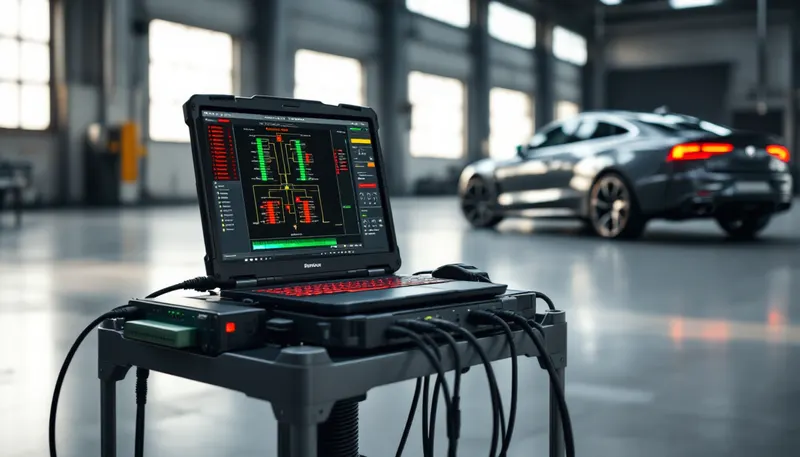
We confirm with the XENTRY ABC test, which reads the pressure held at each strut over time, and with a clean-and-check: the strut is wiped, the car is driven and parked, and the seal is inspected again. We also check the strut's hose and its connection at the valve block, because a weep at a fitting can look like a strut from below.
Struts are $1,400–$2,800 each, and we replace what is leaking rather than a set; where both fronts are original we say the second is likely to follow and let you decide.
The tandem pump is two pumps on one shaft, driven off the engine: a conventional power steering pump and a high-pressure radial piston pump for ABC. It bolts to the front of the engine, M113, M137, M275 or M273 depending on the car, fed from the same reservoir as the steering.
It fails from contaminated fluid, which scores the pistons and lowers output pressure, and from running low when a strut leaks. The symptoms are a whine that rises with steering effort, slow rise after start, and a 'Visit Workshop' message for pressure build time. The replacement is $1,500–$2,800 and includes a flush, because installing a new pump on dirty fluid repeats the failure, and a check of the pulsation damper at the pump outlet.
ABC fluid is Pentosin CHF 11S, a synthetic hydraulic oil, and it degrades with heat and with the wear particles every seal and valve releases into it. Dark, cloudy fluid in the reservoir is a reliable predictor of a pump or valve block failure within a year or two. Mercedes never published a firm fluid interval for most ABC cars, and that silence has cost many owners a pump.
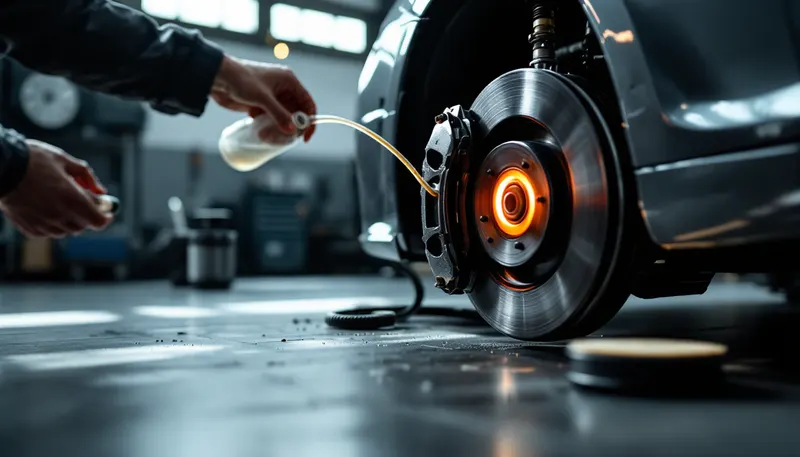
A flush is not a drain and fill. The reservoir holds only a fraction of the system's fluid; the rest sits in the struts, accumulators, lines and valve blocks. We perform the rodeo procedure through XENTRY, which cycles each corner up and down repeatedly while fresh fluid is drawn from the reservoir and old fluid is expelled, replace the reservoir filter, and repeat until the returned fluid is clear. The job is $350–$550.
Owners who flush every two to three years, or sooner when the fluid darkens, keep ABC on the road; owners who do not generally meet us for a pump instead.
The accumulators are steel spheres with a nitrogen charge behind a diaphragm, mounted near each axle's valve block. They store pressure so the pump need not respond to every bump and soften the circuit so the ride is compliant. As the diaphragm ages the nitrogen leaks into the fluid, the sphere goes solid, and the ride turns harsh and jittery over small inputs even though the height is right.
Pulsation dampers do a similar job at the pump outlet, smoothing the pressure pulses from the piston pump so they do not hammer the valve blocks. A failed damper puts a vibration into the steering. Accumulators and dampers are $400–$900 per unit, usually replaced in pairs by axle.
After a strut, valve block or pump the system has to be calibrated. Height is measured at each wheel, the values are entered into XENTRY, and the control unit stores the level sensor offsets. The pressure sensor is calibrated against the accumulators, and the rodeo routine bleeds air and confirms each corner responds at the correct speed.
Skipping this leaves a car that leans, holds a corner high or repeats a 'Visit Workshop' fault for plausibility. Every ABC repair ends with the calibration and a road test with live data visible.
The range of $350–$2,900 per repair runs from a flush at $350–$550 to a strut at $1,400–$2,800. In between are the valve blocks at $900–$1,900, accumulators and dampers at $400–$900 and the tandem pump at $1,500–$2,800 including the flush. A failed strut with dark fluid usually needs two line items, both shown in the estimate.
Pricing differs between models: a W221 or C216 strut costs more than a W220 one, and R230 SL parts carry their own numbers. ABC repairs are covered for 2 years parts and 2 years labor, up to 24,000 miles, nationwide.
Struts, valve blocks and pumps are genuine Mercedes or the original supplier's part. Remanufactured struts from a specialist rebuilder are offered on older W220 and R230 cars as a lower-cost route. Accumulators are new, because a used sphere has already lost charge.
The fluid is CHF 11S only, with the reservoir filter replaced at every flush. The price is driven by the failed component, by the model, since W221 and C216 parts cost more than W220 ones, and by whether a flush is needed, which it always is when the fluid is dark.


Pricing
| Service | Price range | Typical time |
|---|---|---|
| ABC strut, each, with calibration | $1,400–$2,800 | 3–5 hours |
| Tandem pump with flush | $1,500–$2,800 | 4–8 hours |
| Valve block, front or rear | $900–$1,900 | 3–5 hours |
| CHF 11S rodeo flush and reservoir filter | $350–$550 | 2–3 hours |
| Pulsation damper or accumulators | $400–$900 |
Dallas-area independent ranges per component; fluid condition decides whether a flush is added, and the estimate lists each line first.
The offer
Risk reversal
Covered for 2 years parts and 2 years labor, up to 24,000 miles, nationwide
No deposit, no card online: you approve the written range before any part is ordered
Published range
$350–$2,900 per repair
2–8 hours
Models
Questions
Only if it is holding height and the reservoir is not empty. The red message means pressure or level control is lost; a strut that has let go can leave the pump running dry, which destroys it within miles. If the reservoir is low or a corner is on its bump stop, arrange a tow.
Every two to three years, or whenever the reservoir fluid turns dark or cloudy. Mercedes never published a firm interval for most ABC cars, which is why so many pumps fail. The rodeo flush through XENTRY replaces the fluid in the struts and accumulators too.
Correct height with a jittery, hard ride points to the accumulators. The nitrogen charge behind the diaphragm leaks away with age, the sphere stops absorbing pulses and every small input reaches the body. Pulsation dampers at the pump produce a similar feel with a steering vibration. Both are $400–$900 per unit.
For a car in good condition, yes. A single strut or a pump is a fraction of what the car is worth, and a flushed system with fresh accumulators behaves as it did new. With several leaking struts, a failing pump and dark fluid, we lay out the full figure first.
Conversion kits with coil springs and passive dampers exist for the W220 and R230. They remove the hydraulics, the warnings must be defeated electronically and the ride is a fixed compromise. We will discuss it for a high-mileage car; on a W221 or C216 the repair is almost always better.
The $1,400–$2,800 per strut figure covers the strut, the seals and fittings at the valve block, the fluid used, the calibration in XENTRY and a road test. A flush is quoted alongside when the fluid is dark, and the strut is covered for 2 years parts and 2 years labor, up to 24,000 miles, nationwide.
Related
Air struts, compressor, valve block, leak tracing
Factory XENTRY scan, guided tests, SCN coding
Book ABC (Active Body Control) Suspension Repair in Dallas
Active Body Control hydraulic suspension repair for C215, W220, R230, W221 and C216 Mercedes-Benz: struts, tandem pump, valve blocks, accumulators and CHF 11S flush, calibrated in XENTRY.